DigitalOcean’s Agentic Inference Cloud: What GTC 2026 Means for Hosting Buyers
At NVIDIA GTC 2026, the industry’s narrative decisively shifted from AI training to production inference. Reuters described an “inference boom,” and DigitalOcean used the event to unveil its Agentic Inference Cloud—a coordinated push with NVIDIA to make always-on AI agents a manageable hosting workload. For website owners, sysadmins, and cloud buyers, the announcement is more than GPU marketing: it signals that inference latency, token economics, and full-system optimization (CPU, RDMA fabric, vector storage) are now core hosting evaluation criteria. DigitalOcean reported more than 43,000 OpenClaw deployments since the tool gained traction, with over 11,000 currently active in production according to partner coverage. The Richmond data center, HGX B300 systems, and Dynamo 1.0 integration reshape how smaller teams can run agentic workloads.
Related ServerSpan guide: KVM VPS vs Container VPS: Docker, CI/CD, AI Agents, and Self-Hosting Compared.
The Inference Era: Why Hosting Buyers Must Rethink Infrastructure
For most of the past decade, cloud GPU conversation centered on training ever-larger models. At GTC 2026, NVIDIA and its partners made clear that the operational weight has moved to inference—generating outputs from trained models at scale. This is where AI becomes a product: cost per token, time to first token, orchestration, and uptime now matter as much as model quality.
The practical impact on hosting selection is significant. Inference workloads are sensitive to the entire system, not just the accelerator. The source coverage notes that even the CPU re-entered the discussion because inference pushes teams to optimize memory bandwidth, interconnects, and scheduling. For a hosting buyer, this means a bare GPU count is a weak metric. You should examine the network fabric, storage throughput for model weights and retrieval, load-balancing options, and managed data services that support agent memory.
For traditional web hosting customers, this may feel distant. But any SaaS, agency, or platform adding AI features—search, chat, autonomous agents—now inherits an inference infrastructure problem. The GTC messaging suggests that cloud providers must deliver a cohesive stack rather than isolated rentable hardware.
Inside DigitalOcean’s AI Factory and Richmond Facility
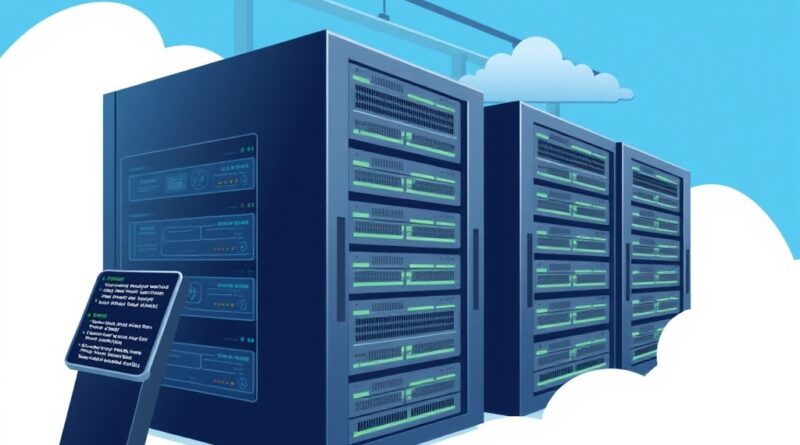
DigitalOcean’s headline move is the Agentic Inference Cloud, described as an “AI Factory” built with NVIDIA. The most concrete infrastructure detail is a new Richmond data center purpose-built for AI inference. According to the primary source, it features NVIDIA HGX B300 systems and a 400 Gbps non-blocking RDMA fabric designed for demanding reasoning and agentic workloads. We do not have independent benchmarks for B300 in this research, but the inclusion of a high-speed RDMA backbone indicates an attempt to remove multi-GPU communication bottlenecks that plague distributed inference.
On the software layer, DigitalOcean is bringing NVIDIA Dynamo 1.0 to DigitalOcean Kubernetes. Partner coverage (AIdroplet/Hawkdive) states that Dynamo 1.0 on DO Kubernetes has delivered up to 3x inference cost reduction on Hopper GPUs and that models running on DigitalOcean Serverless Inference with NVIDIA Blackwell GPUs showed roughly 4x better performance than HGX H200 in internal tests. These are vendor or partner-reported figures; treat them as directional until third-party validation appears.
Model access is expanding. DigitalOcean highlights options optimized for reasoning, long-context, multimodal, and agentic use cases. Via deep NVIDIA integration, build.nvidia.com now exposes DigitalOcean serverless endpoints for open models such as GLM-5, Kimi-K2.5, and Minimax-M2.5. Additionally, NVIDIA Nemotron 3 Nano is listed on DO’s inference platform with a sparse MoE architecture and a 1-million-token context window—useful for long-running agent tasks.
The ecosystem also includes less glamorous but critical hosting components: DigitalOcean Load Balancers for traffic distribution, high-performance Network Attached Storage to accelerate inference and fine-tuning, and OpenSearch Managed Databases for large vector datasets that power retrieval-augmented agents. This stack addresses the operational glue that generic GPU rental often leaves to the customer.
Deployment Paths: From build.nvidia.com to 1-Click Droplets
A key promise is friction reduction between experimentation and production. DigitalOcean and NVIDIA are linking build.nvidia.com directly to DigitalOcean Serverless Inference: a developer can prototype with high-performance models in NVIDIA’s API catalog, then deploy seamlessly to GPU Droplets without rebuilding their stack. For NVIDIA NemoClaw—an open-source stack for always-on assistants like OpenClaw—DigitalOcean offers a 1-Click Droplet setup and a tutorial, shortening time-to-production.
The adoption signal is notable. DigitalOcean states more than 43,000 OpenClaw deployments have occurred, and Hawkdive’s recap cites over 11,000 active OpenClaw deployments currently in production. Additional services such as Backups, Snapshots, and Gradient AI Serverless Inference are positioned to harden these agentic workloads.
For a sysadmin, the workflow looks like: start on serverless endpoints to validate token latency and cost; promote stable agents to a GPU Droplet or Kubernetes with Dynamo; attach Load Balancers and OpenSearch for scale. The 1-Click path reduces initial configuration risk, but you should still verify region availability (Richmond is explicitly named; global presence for these features is not confirmed in the research) and whether your compliance needs match the data-center geography.
Tradeoffs, Cost Caveats, and Operational Risk
The benefits are real for AI-native builders: a unified control plane, managed RDMA, vector databases, and NVIDIA-optimized runtimes. However, hosting buyers should apply normal due diligence. The research does not confirm public pricing tables, renewal rates, or SLA numerals for the Agentic Inference Cloud. Serverless inference convenience can obscure per-token expenses at scale; we have no confirmed rate card, so model your own projection before migrating.
Performance claims (4x vs H200, 3x cost cut on Hopper) are internal or partner-sourced. Independent benchmarks on the Richmond B300 fabric are absent. Lock-in is another angle: the stack leans on NVIDIA Dynamo, NemoClaw, and build.nvidia.com catalog ties. If you later need multi-cloud portability, containerize agents explicitly and keep model weights in portable storage.
For a more detailed walkthrough of this part of the topic, read Cloud Hosting vs. VPS Hosting: What’s the Real Difference?.
This is not a substitute for standard VPS, WordPress, or shared hosting. It is specialized GPU infrastructure for inference-heavy applications. Traditional site owners will see no benefit and should not chase accelerator specs. But for teams running agents, recommendation engines, or multilingual chat, the integrated load balancing, NAS, and OpenSearch pieces reduce the typical “I assembled this from scratch” tax.
Practical Checklist / Key Takeaways
- Confirm whether HGX B300 + 400 Gbps RDMA is available in your required region or only Richmond.
- Benchmark your real workload’s time-to-first-token and cost-per-million-tokens on serverless before committing.
- Use the build.nvidia.com → DigitalOcean Serverless → GPU Droplet path to avoid early over-provisioning.
- Plan vector retrieval early: evaluate OpenSearch Managed Databases or your own NAS-backed store.
- Verify backup and snapshot support for agent state, not just VM images.
- Treat claimed 3–4x efficiency gains as vendor data; seek community benchmarks.
- Document an exit plan in case NVIDIA-native tooling lock-in conflicts with future infra strategy.
Conclusion
NVIDIA GTC 2026 confirmed that inference, not training, is the new operational frontier for AI. DigitalOcean’s Agentic Inference Cloud and AI Factory represent a serious attempt to package GPUs, RDMA fabric, managed storage, and NVIDIA software into a buyer-ready product for always-on agents. For hosting buyers with inference needs, the announcement lowers entry friction and puts system-level optimization on the table. Yet as with any emerging cloud tier, the wise move is to validate performance claims, clarify pricing, and architect for portability before moving production traffic.